
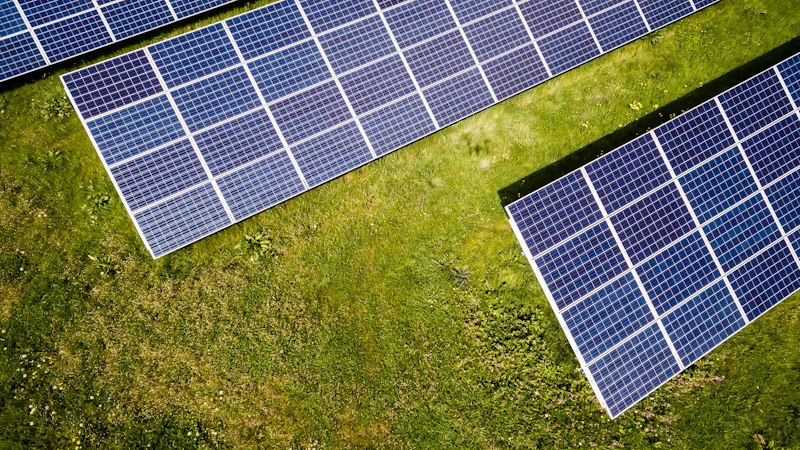
Solar salespeople want to sell you the biggest system possible. Here's how to calculate exactly what you need — and nothing more.
Start With Your Actual Usage
Pull up your last 12 months of electric bills. Find the kWh usage for each month. Add them up and divide by 12 to get your average monthly usage, then divide by 30 for your daily average.
Most American homes use 25-35 kWh per day. Write down your number — everything else flows from it.
Peak Sun Hours: The Variable Nobody Explains
Solar panels are rated at 1,000 W/m² of sunlight (called "Standard Test Conditions"). In the real world, you get this intensity for only a few hours per day — these are called "peak sun hours."
- Southwest US (Arizona, Nevada): 5.5-6.5 hours
- Southeast US (Florida, Georgia): 4.5-5.5 hours
- Midwest: 4.0-5.0 hours
- Pacific Northwest: 3.5-4.5 hours
- Northeast: 3.5-4.5 hours
The Calculation
System size needed = Daily kWh ÷ Peak sun hours ÷ System efficiency
System efficiency accounts for inverter losses, wiring losses, and temperature derating — typically 75-85%. Use 0.80 as a conservative estimate.
Example: 30 kWh/day ÷ 5 peak sun hours ÷ 0.80 = 7.5 kW of panels
Battery Storage Sizing
If you want backup power for outages, size your battery bank to cover your critical loads for 1-3 days without solar input.
Critical loads (what you actually need): refrigerator (1.5 kWh/day), lights (0.5 kWh/day), phone charging (0.1 kWh/day), internet router (0.2 kWh/day). Total: about 2.3 kWh/day for basics.
For 2 days of backup: 4.6 kWh minimum. One Powerwall (13.5 kWh) gives you almost 6 days of critical load coverage.
The Honest Bottom Line
- 8 kW of solar panels
- 13.5 kWh of battery storage (one Powerwall or equivalent)
- 7.6 kW hybrid inverter
This will cover 80-90% of your annual electricity needs, with the grid as backup during extended cloudy periods.
More in Off-Grid Power
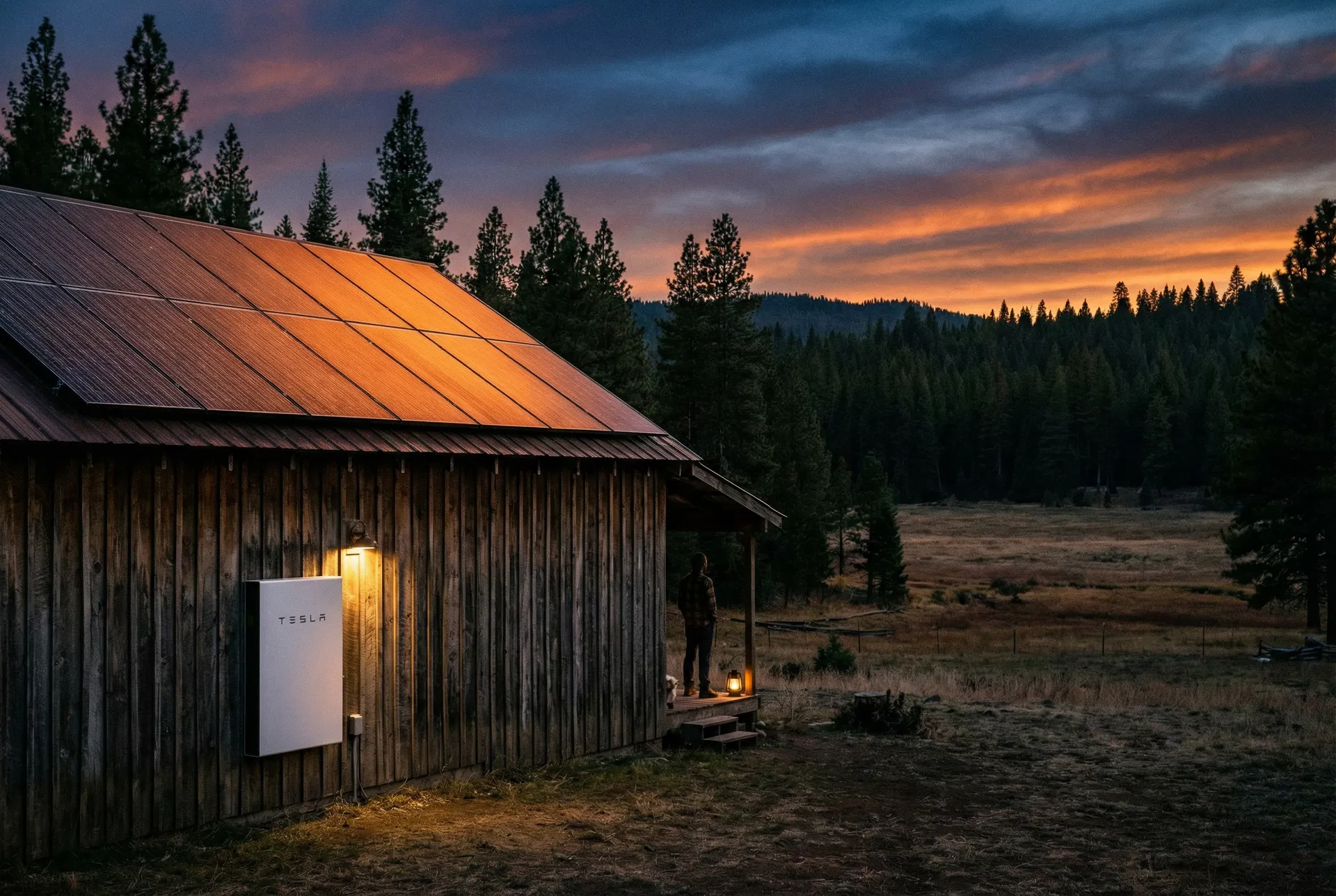
Tesla Powerwall + DIY Solar: What Nobody Tells You Before You Buy
I spent six months researching off-grid power before pulling the trigger. Here's the honest breakdown of costs, gotchas, and whether it's actually worth it.
Build Your Own LiFePO4 Battery Bank: Complete Guide
Skip the $10,000 commercial units. With the right cells, a quality BMS, and this guide, you can build a 10 kWh battery bank for under $3,000.